Nothing good about Good Friday
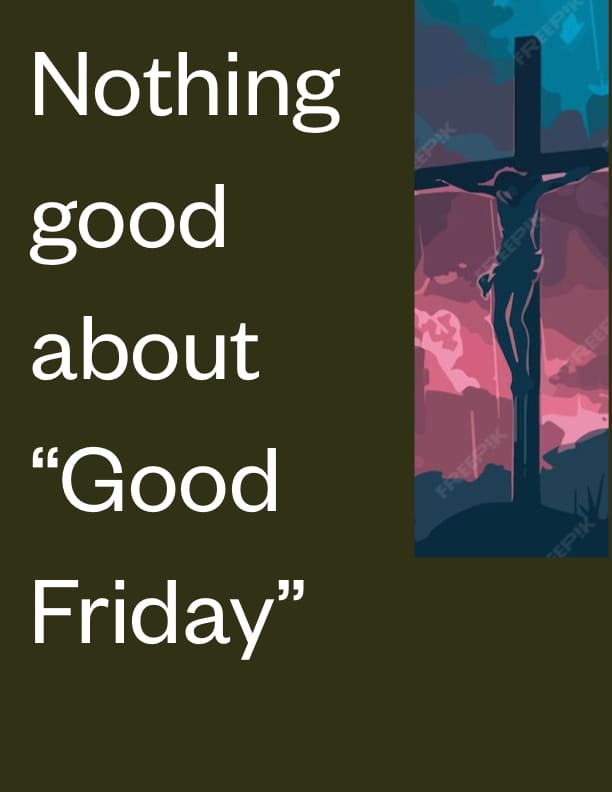
The eventual cessation of unnecessary suffering—even in a glorious turn of events—does not undo the suffering.
As Christianity has dubbed the Friday before Easter “Good Friday” the name sticks even though it commemorates the execution of Jesus of Nazareth by Rome. In fairness, Grim Friday (my name for it) was established from a post Easter perspective. That is to say, Christians looked back on Friday after they’d already begun celebrating Easter, the celebration of Jesus’ resurrection from the dead. And if you add a little bit of atonement theology (a perspective I find God-awful) to the mix, in a warped way one could believe Jesus’ crucifixion was good because without his death Jesus logically couldn’t have been resurrected, and moreover the sacrificial death God demanded in order to forgive human beings for their sins wouldn’t have transpired. Otherwise, there’s no way to make Grim Friday good.
Since I find atonement theology reprehensible, there’s no way Grim Friday can ever be good. As pivotal Christian scripture scholar, Dr Frank Stagg, remarked, recoiling at the prospect of atonement theology, “There had to be a killing in order for God to forgive us?”’
Thanks for reading David Albert Farmer Substack! Subscribe for free to receive new posts and support my work.
Thank you for reading this far. And if you’re progressive I know you’re giving me the benefit of the doubt. I will try my best to make your trust worthwhile.
This is Grim Friday, and we acknowledge it because Jesus of Nazareth did suffer and die needlessly—not to appease God by any stretch of the imagination but rather because his powerful political enemies decided to shut him down. His relentless preaching about an eternal Empire (not kingdom!) of God made small-minded and paranoid power people in Rome, notably in this case Emperor Tiberius, feel the mighty though ultimately measly Roman Empire was being diminished and the absolute power of the Roman Emperor, Tiberius, was being called into question. It was of course, but the resolution didn’t have to be violent. Obviously, Tiberius disagreed.
So? Well, I’m glad you asked.
- God did not want Jesus to die, did not will that Jesus would die.
- Jesus could have avoided being executed by Rome (not by the Jews, his own people) had he allowed Tiberius and some sellout Jewish leaders to silence him or dictate his message; therefore, he died willingly believing his message about the Empire of God, a God who loved all people rather than a select few, had to be preached and demonstrated regardless of consequences.
- Crucifixion was the most gruesome and painful method of capitol punishment Rome had in its bag of tricks. It was reserved for enemies perceived to be the greatest threats to the longevity and power of its Empire and Emperor. Not surprisingly, Tiberius’ most hated enemies were those he believed were subversive to Rome. Jesus clearly had gotten himself in that company; though he was not an enemy.
- Jesus’ suffering was entirely unnecessary and non-redemptive. Whatever resurrection was, it didn’t glorify Jesus’ grueling, drawn out death by suffocation; that’s what the Roman cross—along with loss of blood from the nails, lack of nutrition and hydration—did. After long hours of hanging on the cross the accused one simply could not raise himself (I do not know of Rome crucifying women) up enough to expand his chest in order to breathe.
Jesus died on Grim Friday in utter agony, exactly what Tiberius intended. Again, Jesus did not have to die to please God or fulfill God’s plan. His death was needless. And resurrection didn’t neutralize the suffering.
It is proper therefore, I think, that we honor Jesus and recall on Grim Friday those like him, past and present, who suffered and died needlessly because they stood with those whose civil and spiritual freedoms were being squashed by political and/or social tyrants.